
What is a Bed Bug?
Bed bugs are one of the most prevalent and annoying pests known to humans. They are found on every continent throughout the world and are capable of surviving in a variety of extreme conditions.
Their intense tenacity and quick rate of reproduction make them one of the most difficult bugs to exterminate. While many people must deal with infestations and bites, there are many steps that can be taken to rid the home and ensure that future infestations are avoided.
What Are They and How Can We Identify Them?
The term actually refers to a host of insects that feed on animals with warm blood and most specifically those that prefer human blood. These bugs belong to the order Hemiptera, which includes almost 100 identified species. Most species of the order feed on plant matter and liquids, but today those that prefer warm-blooded animals are thriving.
The scientific name for this family of bugs is Cimicidae. The most common Cimicidae, is the Cimex Lectularius.
However, there are many varieties throughout the world. Another common bug, the Cimex Hemipterus, was recently discovered. It is originates in Florida and similar places, and primarily infests bats and poultry.
Mature Ones
Mature bugs are usually between 4 to 5 mm long and 1.5-3 mm wide. They are commonly reddish brown in color, giving them nicknames such as the ‘mahogany flat’ and the ‘crimson rambler’. Young bugs, known as nymphs, are transparent and develop their color over a five-part period of maturing.
Have Bed Bug Problems?
Nymphs shed their outer shell five times before they are considered mature in a process that usually takes about 40 days to complete. However, depending on the living conditions, the process can be much shorter or much longer. Nymphs in their first stage of life are only about 1 mm in length.
Physical Make Up
These bugs have a pair of maxillae and a mandible that, combined, are referred to as the stylet fascicle. The stylet has evolved over time to become more elongated and sharper, allowing for easier feeding. The maxillae and mandible help the bug puncture and receive blood.
They are considered to be basically wingless, though they have evolved with flat front wing-like structures. Their bodies are flat and ovular, and become redder after they eat. These bloodsucking insects have six legs that have been developed over time to be best fitted for their preferred habitats. They can climb up surfaces including wood, paper, and even glass.
Males and females differ in their body types. The male body has an abdomen with a flat, sharp end while the female’s abdomen is much rounder. This facilitates survival and ease of breeding, and seems to facilitate the male and female’s different roles.
The Smell
They can also be identified by their strong smell. The smell is caused by oil the bugs emit, and has been described in various ways. Most commonly, however, the smell has been described as being similar to cilantro, coriander and various nuts, including almonds. When frightened, the oil smells similar to ripe raspberries.
These bugs are particularly resilient and can survive in many conditions. Adults go into a state of hibernation when temperatures drop too low, and can even survive extreme temperatures in hibernation.
These tough adaptable bugs can also survive in states of extreme drought or humidity. Their ability to survive in so many environments has made it one of the most common nuisances to a warm-blooded animal.
Where Can They Be Found?
While beds are in fact the place most are found, they can live in almost any space throughout the home and beyond. They are known to infest household furniture, clothing, and cupboards. When they find a host, however, they will usually not stray very far from it.
They often set up and congregate in wood and in furniture seams. They are nocturnal, and only leave their selected home to feed. This is why most are found in the bed.
Hotels have become one of the most common places where people pick up them up and bring them home. The most obvious reason for the high occurrence in hotels is the high turnover rate of guests.
Even one individual who is host can transfer them to the hotel bed, where they will wait for the next individual. It is increasingly important for hotels to thoroughly clean bedding after every use, and even regular cleaning might not kill all of the bugs. Because it is almost impossible to detect one in someone’s luggage or belongings, many individuals then unwittingly transport the bug to their home.
They Can Hide Anywhere
They have even been found in high-end clothing stores, proving that they can cluster anywhere. Infestations in these stores forced them to close in order to eradicate the infestation.
While many individuals believe they are linked to dirty living spaces or people, there is no direct correlation. Most people recommend shaking out clothing and purchases prior to taking them home, to avoid accidentally introducing bugs to the living space.
Because they can survive so long without eating, they can inhabit almost any place. They are capable of locating a host from many feet away and will travel long distances to feed. Thus, even in seemingly ‘safe’ locations, there can be a threat of an infestation.
How Do They Travel & Get In Your Home?
These bugs crawl across household surfaces and can crawl up to 500 feet to reach a host. They cannot move very quickly, but can be impossible to detect and only travel at night.
While they do not have wings, they do have two frontal flaps that give the appearance of a set of wings. They can climb up to great distances and often reach lower spaces by jumping from above. However, they are not capable of jumping across floors or furniture.
They travel to new homes undetected and in a variety of ways. Many will latch on to a pet, luggage, or clothing when an individual is traveling or visiting someone’s home. Many travel between homes during overnight stays or visits.
Furniture and Bedding
Furniture and bedding that is brought in to a home can be infested. Thus, it is important for individuals to check all furniture and clothing before bringing it into the home. While most new furniture should be free, they can populate even before entering a home.
Used furniture should always be thoroughly inspected, as bugs can easily survive even in old furniture for long periods of time. Apartment buildings and housing complexes allow them to travel easily between homes.
It is important to ensure that the home is as secure as possible, as they travel through cracks in the walls and ceiling, through plaster, and even through air and heating units.
How Do They Reproduce?
Their reproduction process is known as traumatic insemination. The male pierces the female in the abdomen and releases his ejaculatory material into her. From there, the material travels to the female’s semen storage structures and then to her ovaries, where conception occurs.
Females can lay up to 5 eggs per day, and over 500 eggs in a lifetime. The eggs are about 1/25 of an inch long and are ovular and yellow in color. They are usually clustered together and can be hidden throughout the home in a variety of protected locations. Eggs can hatch in as little as one week, but can take longer to hatch in unfavorable conditions.
Because males choose their mates according to size, they most often inseminate those who have just eaten and are engorged with blood. For this reason, it is common for a male to attempt to mount another male. When this occurs, males will emit a pheromone known as the “alarm pheromone”.
This will usually warn another male from attempting to mate. This pheromone is also released when a bug is being attacked or otherwise disturbed, sometimes resulting in the raspberry smell that can be detected when it is frightened.
Building Up Resistance
Recent studies have shown they have developed to avoid contracting infections and diseases during the reproductive process.
Females are equipped with a pocket of antibacterial material that the male injects his semen into, preventing the female from contracting disease in the violent process. This has allowed them to become even more resilient and prevented them from succumbing to disease.
What Are the Signs of an Infestation?
There are signs of infestations, but they can go unnoticed for extended periods of time. Signs include insect fecal matter and molted shells, and possibly smears of blood on furniture or bed sheets.
In places with large infestation, there may even be visible dark spots and shapes in the furniture where they live. Scientists have claimed that there are dogs that are trained for detection, and some studies have shown them to be up to 97% accurate in their assessments.
These dogs locate bugs in the home and can usually determine both habitats and feasting areas. Individuals can also attempt to coax bugs out of hiding spots using heat or carbon dioxide, which the bugs will flock to.
Historically, many individuals used fires and other heat producing sources to coax out and kill the bugs. In the process of molting, they leave their shells behind. The shells resemble a living bug but are clear and skeletal in appearance. These shells are one highly reliable sign of an infestation, though they should not be confused with the shells or molts of another insect.
Symptoms of an Infestation and Bites
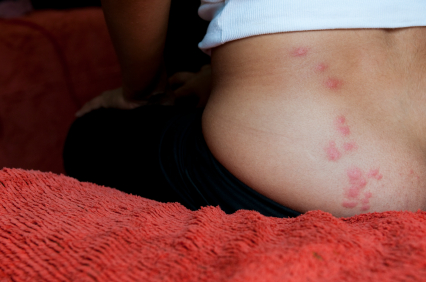
The bites can range in severity. For many people, the bites are small and may even go unnoticed. However, they can cause severe skin reactions including welts and swelling.
Those who are particularly allergic or sensitive to the bite can develop symptoms of lethargy and even mental health problems. Most severe symptoms are caused by the infection of a bite from scratching and irritation. Studies have shown that these bugs can carry human infections and disease, but have not conclusively shown that they can further transmit them.
However, there is some evidence that animals can contract diseases carried. Furthermore, while they do not pose an immediate health risk, individuals should exercise caution when searching for the bugs, as those who have consumed infected blood can spread it.
Difficult to Diagnose
Because most individuals do not develop severe symptoms from bites, it can be difficult to diagnose and treat an infestation. Many individuals confuse these bites for those of fleas or mites. A thorough investigation of the home can help determine what is causing the bites.
How can bites be treated?
Because most people do not have severe responses, there are no particular treatments available, but those with symptoms can use over the counter creams and topical treatments.
However, those with severe reactions can seek further care. One method of treatment is to apply a mixture of baking soda and water to the affected area. This has been said to reduce inflammation and irritation of the bites. Many people find that herbal and natural substances such as lemon juice and aloe gel can alleviate symptoms.
Finding Relief from Bites
Those suffering from itching and other irritation might find relief in cortisone cream or calamine lotion.
If there are highly severe symptoms or responses, it is possible that the bites can be attributed to something else. Those with health risks and signs should consult with a doctor or other medical professional to ensure proper treatment and avoid further danger. Elimination of the infestation is the only known way to avoid further symptoms.
Health Risks
While most people are not at risk from the bites directly, there are possibilities for health risks. Because bugs remain engorged with their host’s blood after feeding, those checking for them in hotels and other public locations are at risk of being exposed to infected blood.
Most serious risks borne out of bites occur when the bite is scratched and becomes infected. The bacterial strain MRSA has infected bug bites that are scratched and opened to the bacteria.
This can cause severe infections of the bite locations, and possibly even further health risks. For this reason, those with bite marks are advised to avoid itching and irritating them, as this is often the cause of severe symptoms.
How Do I Get Rid of Them?
Ridding the home can be an exhausting and frustrating process. In order to ensure proper and adequate extermination and removal, it is important to perform all steps necessary.
The home should be thoroughly inspected. Once all nesting locations have been determined, there are a variety of methods available for proper extermination of the bugs.
After the infestation has been destroyed, there are further measures that should be taken to ensure that future infestation will not occur. Treating infestations has proven increasingly difficult. While there are many methods available, most specialists recommend using several methods in conjunction with one another.
Step 1: Location
The first step, and one of the most important in preventing re-infestation, is to meticulously inspect the home. Because they are particularly timid insects, they prefer dark spaces and can hide for days before making an approach. Thus, most specialists recommend using a red light when searching for the bugs at night, as white light scares them away.
They can hide in the most inconspicuous places, and many have been found in baseboards, in the seams of clothing and furniture, and even under screws. When inspecting the home, all furniture should be pulled away from the walls and all pieces should be checked for bugs. While the furniture is pulled away from the home, individuals should inspect every seam throughout the home.
All nooks and crannies should be checked, as they often hide in cracks and holes in the wall.
Dogs and Monitors
There are carbon dioxide monitors that are said to detect the presence through measurements of excess carbon dioxide in the home. The manufacturers of these monitors claim that they have been refined to detect only the excess gases of the bugs, but further testing is necessary to determine if these monitors actually work.
Another such method is the use of dogs that are specially trained and licensed in detection.
These dogs are said to be over 98% accurate and can help individuals find areas that are infested. However, these dogs are also expensive to use and can only show where the bugs are located. However, they can be a good option for large areas, as the dogs can effectively show all areas infected.
While messy or dirty homes are not necessarily more likely to be infested, they do provide an environment that makes it easier for the bugs to hide. For this reason, those dealing with infestations should rid their home of clutter and do a cleaning of the entire home.
Step 2: Preparing for Removal:
Those trying to rid their homes must first repeal other household vermin, as the bugs could also be feeding on them.
Common warm-blooded creatures like birds, rodents, and similar vermin can provide a feeding ground and hiding spot for bugs. Without first eliminating this threat, re-infestation is highly likely. Pets in the home should also be checked and taken to a veterinarian if infestation is suspected.
The home must then be sealed from further infestations through caulking and sealing of cracks. All surfaces should be vacuumed, and bed sheets and blankets should be thoroughly washed.
Individuals are also advised to use strong cleaning solutions that will both force the bugs out and sanitize home surfaces. Other sources advise individuals to use double-sided tape or other sticky substances to trap the bugs.
Step 3: Exterminating and Removal
While some pesticides have been shown to work, they have also been shown to increase their strength and resistance. Over the years, tests have shown that many species have become resistant to pesticides and some are even strengthened by pesticide usage.
However, there are some pesticides that are still successful in exterminating. It is important to choose a pesticide that will not be harmful to individuals or animals living in the home.
Many professionals recommend vacuuming and using heat trapping methods and mattress wrapping to starve the bugs. There are carbon dioxide traps and other monitors that will capture them, but these are only useful in conjunction with other methods.
Steam Cleaning
Steam cleaning of the home can be helpful in repelling these pests. At a high enough temperature, a steam tool can kill them. Primitive cultures recommended the use of natural fires to lure out and exterminate the bugs. While these bugs are particularly resilient in many temperature conditions, there are some tools that can provide a hot enough heat source to kill the bugs.
However, individual homeowners may not be able to find a steam tool that can reach a temperature adequate to kill the bugs.
There are more intense methods of extermination and repellant, but their high cost make them viable only for some situations. One such method also uses heat to create temperatures high enough to kill bugs. This method must be executed by professionals, and can cause up to $2,000 for an apartment.
For this reason, this method might be best for apartment buildings or complexes, as technicians can heat an entire unit of buildings. This method might also be best for homes that are more cluttered or have more individuals living in them.
Getting Rid of Tough Infestations
Even with these combinations of identification and treatment, however, bugs can remain. Thus, it may be advisable to hire outside help or pest management to eradicate the bugs. Pest management companies will be able to diagnose an infestation and to find the most helpful means of destroying the bugs.
In European countries, dry ice machines are used to freeze the bugs. Similar to thermal treatment, the temperature must be dropped low enough to kill them. This method has not been as extensively tested, but seems to have been successful in these countries.
Step 4: Preventing Further Infestations:
Even when an individual has followed all the steps for extermination and elimination is possible that some may have survived and may re-infest the home. However, you can prevent this type of re-infestation.
One simple way to avoid further infestations is to move furniture, particularly the bed, away from the wall. This prevents the bugs from reaching furniture and living surfaces. Tape and barriers can also be placed around the bed to trap any that may have survived.
Mattress and furniture covers can also be helpful in preventing further infestation, as any surviving bugs will starve and slowly die out. These covers are sold by many companies, but should only be applied once risk of infestation has been removed.
For those with particularly severe infestations or who have experienced multiple infestations, more steps may need to be taken. While this is not possible for everyone, those who have been chronically plagued may find it necessary to replace furniture or household structures.
However, new furniture should not be purchased until the home is completely free of the bugs. If even a few are still present, they can repopulate and infest the furniture. Old furniture that has become infested should also not be taken through the home, as this can spread the infestation.
How to Choose a Pest Control Company
Choosing any type of home management professional can be difficult. With pest control, there are many factors that should be considered. The first place to begin should be the local phone book or other directory, where there are certain to be many listings for pest control companies.
However, many of these companies may be unreliable or may use practices that are not preferable. For this reason, it is advisable to do some outside research. There are many websites and companies that offer reviews from those who have used a service before.
Even without these user reviews, there are some guidelines that can ensure the best pest control service. Individuals should always ensure that a pest control company is registered to use pesticides and other chemicals. While this may seem obvious, there are many companies that are not registered and that can cause serious damage to the home or homeowner’s health.
Communication is Key
It is also important to communicate heavily with the pest control companies. The company should preferably use more than one method of control, including those that have been listed above. Companies should be willing to negotiate terms of agreement and methodology. Those companies that refuse to may not be able to provide adequate service.
How Do They Find Food?
These parasitic insects are primarily nocturnal and considered to be ectoparasites, as they exist outside of the host. Like most other parasites, they are particularly evolved to survive and locate food efficiently. They use heat and carbon dioxide output to locate a host, and usually form colonies and dwell near their host. A bug can locate a host from up to five feet away, and can travel up to 100 feet to feed.
These bugs are equipped with a form of anesthetic that they inject into the host prior to feeding. This prevents the host from feeling any pain while the bug is feeding. They also inject a coagulant to prevent the host from bleeding out while the bug is feeding.
Once the bug has pierced its host, it runs its jagged mandibles over the wound, creating a hole sizable enough for it to receive enough blood. Most feed for about 5 minutes, but it can take up to 10 minutes for one to be sated.
Feeding Statistics
They can eat up to 6 times their own weight and after eating they appear highly engorged. These bugs are capable of surviving for up to a year without eating, but when a host is available, they will feed every 5 days.
While they are most known for feeding on human blood, they are capable of and willing to feed on any warm-blooded animal available. For this reason, they can also become nuisances for family pets and other animals. Many animals can develop infections and illnesses from the bugs, so it is important for pet owners to ensure that their pets are not infested.
History
These pests seem to have been with human populations since ancient times. There are accounts of infestations in ancient Greece written as early as 400 BC. Pliny the Elder, a Roman writer and philosopher, wrote about the use of these bugs as a treatment for common ailments such as bites and infections.
Historical evidence shows that the bugs were considered medically useful by many societies as late as the 18th century. Early methods of repellant and avoidance include the use of bed barriers and leaves tied with hairs to confuse the bugs.
They are also sometimes known as ‘bat bugs’ because many scientists believe bats were their first hosts. The bugs then infested throughout the Mediterranean, most particularly in caves where bats and humans dwelled together.
Ancient History
When ancient people began to form civilizations and settled down for longer periods of time, the bugs became commonplace. According to archeological evidence, including fossils, bugs can be dated as far back as 3,500 years ago. While many civilizations did indeed consider the bugs to have medical potential, there was advice for their removal.
For the most part, this advice included folk remedies like hanging a bear skin in the home.
Population Increase
These bugs began to populate throughout the world as individuals began to migrate. Evidence suggests that the bugs more often infested the homes of the poor. This is most likely because the poor often used primitive heating systems that provoked the bugs and were rarely able to change their bedding.
The name comes from both Greek and Roman words. The Roman term, Cimex Lectularius, literally meant bug of the bed. Coriander may also have come from the Greek word, Coris, because the bug’s smell was similar to the herbs.
As these parasites spread throughout the world, they were more often recognized as a nuisance. In the 1800’s, people would soak their beds in hot water, arsenic, and sulfur in an attempt to destroy the bugs. These early methods of removal were often dangerous and usually provided only limited relief. Throughout the 1800’s and 1900’s, they became increasingly prolific. This created the need for proper removal and eradication of infestations.
How Have Treatments Evolved?
Throughout the 1900’s, fumigation was the most popular method of destroying these bugs. However, fumigation was often costly and dangerous. Many people were injured or killed by the poisonous gases used. Many times, people used cyanide to kill them. Infestations decreased rapidly throughout the 1940’s and 1950’s.
Most people have attributed this to the use of DDT as a pesticide. DDT brought long-term relief from infestations, as many tests showed that the pesticide often continued to destroy the bugs even years later. However, the use of DDT eventually backfired, as these bugs became increasingly resistant to it.
As parasites, they are particularly capable of adapting to and surviving under extreme conditions. Thus, the bugs quickly evolved to resist DDT and other pesticides. Some studies have even shown that the pesticides have made the bugs stronger and more resilient. This effect has made them even more difficult to kill.
Pesticides
Currently, there are some pesticides available that are successful. The most recently successful pesticide is the chemical Propoxur. The chemical has been shown to be more highly successful in killing the bugs and has residual effects for up to five weeks.
However, the Environmental Protection Agency has found that the pesticide can be harmful, and its production has been discontinued. On its website, however, the EPA offers various methods of treating an infestation, and even has a search tool to help individuals choose from over 300 chemicals that can help kill the bugs.
Still, most professionals strongly advise the use of a methodical approach including several steps. While previous removal was centered on pesticides, they have proven to be relatively ineffective when used alone. Because they acclimate to their surroundings and to the weapons used against them, a more targeted approach is increasingly necessary.
What’s Up With the Increase in Infestations?
While infestations reached a low in the mid-20th century, they began to rise again throughout the 1980’s and 1990’s. A recent survey by the Sydney Department of Medical Entomology found that infestations have increased by 5000% since the year 2000.
There are many possible reasons for this. Many blame increased travel and immigration. As people begin to travel internationally more frequently, the bugs can more easily travel throughout the world. For this reason, different species of bugs can be found in almost every country. Scientists have claimed that the declines and increases in infestations may be due to the natural life cycle of the bugs.
Becoming Stronger
Their increased resistance to pesticides, and the increased view of pesticides as dangerous and unnecessary, may also have played a part in their resurgence throughout the world.
By strengthening the bugs, the pesticides may have allowed them to populate more quickly and with less barriers. While further evidence is necessary to support this theory, many have argued that its likelihood is high.
Still others argue that infestations have grown due to simple public ignorance. Because so many people are unaware of the risks associated, infestations can spread much more quickly. Recent efforts to educate the public and business sectors may be helpful in reducing infestation rates.
Current State of Growth?
They are currently one of the most populous and annoying parasites. Many countries have experienced decreases in travel due to fear. Recently, news outlets have begun to report related lawsuits.
Many individuals have pursued lawsuits against hotel chains that have given them these parasites. There have even been reports of home and apartment owners suing for preexisting infestations.
These types of lawsuits have lead many hotels to pursue methods of resistance, with varying degrees of success. Some construction companies have begun using supplies and materials that are more resistant.
Construction of Homes
Many home construction companies require the use of heavier materials and better methods of construction to prevent them from entering the home. Some governments have even funded research to find new methods to control these offending parasites. Recent news reports claim that, since 2006, over $250 million has been spent on attempting to destroy them.
Many companies have begun to offer products that are said to reduce the likelihood of infestations and to detect them in the home. These products include transportable heaters, sprays, and protective travel coverings. Many of these products require much more testing and many more are simply feeding off fears.
Where Are They Prominent?
Recent news has suggested that many public housing complexes have shown a particularly high occurrence of infestations. Because these types of complexes have relatively high turnover rates and relatively little maintenance and oversight, they are more likely to populate and are less likely to be exterminated.
There have even been reports of homeless and emergency shelters being closed due to high rates of infestations. Because many of the homeless are unable to purchase new clothing or practice safe hygiene, many shelters become overrun that travel on clothing and individuals.
Furthermore, the higher amounts and close proximities of beds and possible hosts provide a ripe feeding and breeding ground for the parasites.
Costs of Treating High Profile Areas
There are few options for locations like these, as many times treating an infestation can be costly and timely. Inability to buy new mattresses, furniture, and bedding further increases the spread. However, with heavy cleaning and new furniture, there can be relief from infestation. Even higher availability of clothing can provide increased relief from infestation.
However, it is not only those in poverty that are highly infested. In the United States, statistics show that New York City has the highest rate of infestation and population.
Because the city is so tightly packed and has so much of its population living in apartments and other housing complexes, they have spread rapidly. Thus, even those living in more expensive, better conditions suffer from infestations.
Risks in Public Places?
Recent studies suggest that infestations may be a problem in emergency rooms and other health facilities. Because so many people are transferred in and out of hospitals daily, the risk of infestations spreading is high.
While many people bring the bugs in on their clothing, they can also be spread in emergency transportation vehicles and on workers. Once they are introduced into public health facilities, there is an incredibly wide scope of possibility for their spread.
Fear of infestation has lead many health professionals to initiate training programs in hospitals and other facilities. These programs train EMTs and other hospital workers to capably identify and avoid bugs in homes and on patients. Regular inspections and cleanings of medical vehicles can help negate the risk of infestation.
Once a medical facility has been infested, it can be highly difficult to treat. However, with the help of professional treatment companies and the EPA, it is possible to control. Individuals can protect themselves by keeping themselves and others informed of possible risks and risk management.
Public Schools
There has also been recently growing fear of infestation in public schools. Children and adults can unknowingly bring them to schools on their clothing and belongings. While an infestation in a school can have frightening implications, calm and well-planned treatment can decrease negative effects.
Most schools have regular pest control and treatment plans, and parents should be informed about them. Most faculty members should be trained to identify and deal with bug and other pest infestations. Schools that are well maintained and clean will be more easily treated in case of an infestation.
Risk Factors
There are some positions that can put individuals at a higher risk of contracting an infestation. Those individuals that work in positions that bring them through many living spaces are at a higher risk. For this reason, social workers, health care workers, and those that work in childcare should be particularly careful to watch for infestation. Those that must travel for work can also be at a higher risk.
By following the rules outlined for avoiding them in hotels, individuals can lower their risk of contracting an infestation. Many companies have begun training workers and personnel about them so further infestations can be avoided.
Still, it is important to note that almost any individual is at risk of an infestation. With the increasing levels of travel and visiting outside of the home, they can be spread easily and without the host knowing. However, by following a few preventative steps, even those most at risk can avoid an infestation.
How can they be avoided in hotels and other spaces?
Keeping an Eye on Them
While they are almost impossible to see in the daytime, there are ways to ensure that a living space is not infested with the bugs, and to avoid bringing them home. Those who are planning to stay in a hotel should check online reviews and information about the hotel.
There are many sites that offer information about possible infestations. However, individuals should always do adequate research, as one statement about a possible infestation does not always signal an infestation.
Hotels and Risks
When staying in a hotel for a prolonged period of time, it is important that luggage is kept as far from the bed as possible. This will decrease the likelihood of bugs infesting clothing or other belongings. If a hotel offers a luggage rack or similar piece of furniture, it should be used to keep luggage off the ground.
Actually inspecting the hotel room is done in a way similar to that of inspecting the home. Individuals should check the bed first, pulling down the bedding and sheets to check for bugs. All crevices and furniture should be inspected.
Many hotels use insect extermination services, which can often be shown by the presence of white bug powder.
Once leaving the hotel, it is imperative that all luggage and belongings are checked. This will ensure that any present will not travel to the home. If there are bugs, belongings should be thoroughly washed before being brought into the home.
Myths
There are many false assumptions that have been made and propagated about these parasites. The most common is that they are too small to be seen with the naked eye. While adults might be difficult to spot, due to their being nocturnal and small in size, they can be easily spotted. However, nymphs and eggs are harder to locate.
Another common misconception is that they more commonly infest places that are dirty. They are capable of infesting any home or location, provided that there are adequate hosts available.
However, a home that is messier or has more clutter will provide these bugs with more possible locations to hide and procreate. For this reason, treating an infestation can be more difficult and can make an existing condition seem more severe.
While many people believe that leaving the lights on at night will prevent bugs from coming out, this is not true. While they avoid the light, especially when there are people awake, they will still feed when they do not perceive a danger.
A final misconception, and one that often prevents adequate treatment of an infestation, is that pesticides will completely eradicate them. While pesticides can be helpful, it is important that a thorough treatment is performed. While this requires much more work than pesticides alone, it is imperative to preventing further infestations.
Bat Bug Similarities and Differences
Bat bugs are very similar in appearance. Bat bugs, or Leptocimex Boueti, are small insects that feed primarily on bats. However, they will also feed on human hosts when necessary.
These bugs usually live in dark places where bats reside, such as caves and vacant buildings. However, they have been known to invade human living spaces. Usually, they occupy spaces in the home that are vacant or rarely visited, such as the attic. While they normally stay in these places, they can travel to other areas of the house and infect human hosts.
Bat Bug Bites
The bite usually goes unnoticed by humans. However, many have reported that it can become far more painful. This may be because many humans have natural allergies to the saliva and compounds released by the bug when feeding. A bat bug bite can usually be treated with topical treatments and over the counter medications.
An infestation can usually be eliminated using the same methods as for typical infestations. All furniture and household structures should be inspected and treated. Pesticides and pest removal companies can be helpful in treating an infestation of bat bugs.
While these bugs that have bats are hosts are not nearly as common, it is important for those who live in high-risk areas to be aware of the threat. In order to avoid such an infestation, all areas of the house should be regularly cleaned and checked for bat or vermin infestations. By following a few simple steps, most infestations can be easily avoided.
Bug Bites Similar to These Bites
There are many other insects that can cause irritation similar. The most common household nuisance is the flea. Fleas can spread through a home rapidly and without warning. While pets in the home most often spread fleas, animals outside the home can also spread them. Flea bites are usually hard and red, and are most often seen around the ankles.
Another common pest is the louse. Lice can cause severe irritation and itching, but differ in many ways. They are usually centralized around the head and other parts of the body that have higher amounts of hair. For this reason, their bites are sometimes harder to see. However, if itching is isolated in these locations, lice are the most often cause.
Mites
Mites are very often confused for bugs that live in your bed. They can infest homes and are known to feed on human hosts. They are commonly associated with vermin in the home. Often, when a bird or other vermin dies, the mites will leave their previous host and enter a human habitat.
Mites are very small in appearance, but can occasionally be seen with the naked eye. The most common mite of this size is the scabies mite. The scabies mite most often bites at the skin between fingers, at the elbow and knee, and at the shoulder blades.
Scabies
Scabies usually cause a severe rash and itching. Scabies bites require medical attention, but doctors should always ensure that the bites are not due to a different species.
Stay Positive
While they can cause psychological distress, it is important to maintain composure when dealing with an infestation. By methodologically treating an infestation, future infestations can be avoided.
It is important to remember that, while annoying, these bugs have not been shown to cause any significant damage to physical health. Proper treatment is imperative to successfully destroying an infestation.





3 Comments
Adding to treatment section: Since the Bed Bug infestation may take weeks or months to diagnose, the human “carrier” can be leaving the bugs in the car and at work. So even though the home is successfully treated the host can be bringing the bugs back into the home from those locations.
Pets can be treated similarly to a tick infestation. A flea/tick shampoo will kill a live Bed Bug but will not kill the eggs. So the pet will need to be washed every 5-6 days to kill any new Bed Bugs. This has to be done very cautiously since the shampoo could hurt the pet.
Comment to the Bed Bug scent: Even untrained dogs and humans can smell the Bed Bugs once exposed to an infestation.
Comment: The psychological impact of the infestation is something that needs to be discussed as well. As stated above, the Bed Bug is not limited to income, housekeeping skills or location. Unfortunately, the stigma is there, especially in the United States, causing the person with the infested to not mention it to guests, spreading the infestation to others. Or worse, the person with the infestation will ALWAYS see or feel the Bed Bugs even when the infestation is gone.
This was very educational and my family and I live in an apartment complex, I learned that every apartment in our building has cats (except us) and our appartment has recently contracted the bed bugs. The owner of the complex refuses to pay for an exterminator while my husband and I have tried these methods to rid them ,but the weird part is we will find one bug then go through all the motions not see any in the cleaning process then one bug will pop up a few weeks later .I am very grossed out by the bugs because I seen them when they were transparent and then saw a red one and think to myself,”oh Lord is that bug carrying my blood”? Yuck ! But I did get more knowledge of their way of life ,so now I’m better perpared ..Thank you for this information !!
I’m a school bus driver. I have a child on the bus with a big problem at home with bed bugs. The school is aware of this and they are working with the child my concern is She still rides the bus and what about the other children on the bus and myself ..Can we get them from her?