
The History of Bed Bugs
From the Beginning
It is thought that C. lecturlarius may have actually originated in the Middle East, in caves that were inhabited by humans as well as bats. The lineages of the bed bug can be traced by their name as well. In ancient Rome, they were called Cimex, meaning ‘bug’, the species designation lecturlarius refers to a couch or bed.
They are ancient insects and they have lived off hosts since time began. Studies have suggested that they parasitized bats first and then moved on to humans. The bugs inhabited the same caves where civilization began.
With the Growth of Civilization, They Multiplied
These bugs have been found fossilized, dating back further than 3,500 years, and have been found at archaeological sites. During that age, the bugs were used as a potion to try to cure common ailments. They were burned by the Romans and Greeks to make leeches release their hold. To cure snakebite, Egyptians would drink them.
They thrived due to the formation of villages and then cities. Civilization grew and the bugs multiplied and spread all throughout Asia and Europe.
By 100 A.D., they were a well-known presence in Italy, in 600 A.D. in China, in the 1200s in Germany and the 1400s in France. Heat that was generated from cooking and sleeping fires afforded the bugs a comfortable life in the wealthiest families residing in castles and the less fortunate working class living in huts.
Have Bed Bug Problems?
England and Ancient Greece
England first reported the bugs in 1583. Shortly thereafter, they arrived in the Americas, stowing away with the European explorers and the settlers.
In 400 BC, Ancient Greece mentioned the bugs and they were mentioned again by Aristotle. According to Pliny’s Natural History that was first published in Rome around 77 AD, medicinal values for these bloodsucking insects included the treatment of ailments like ear infections and snake bites.
This belief in their medicinal properties continued at least until the 18th century. That is when Guettard recommended using them to treat hysteria.
In the 1800’s
The early colonists brought the bugs with them to the Americas in the 1700‘s. In the earlier part of the 18th century, colonial writings document severe problems with them in Canada and the English colonies. In the 1800s, they were abundant in North America following the arrival of the European settlers.
In an attempt to deter the bugs, their beds were generally made out of sassafras wood and doused the crevices with boiling water, sulfur and arsenic. However, there was not a problem with them in the Indian villages.
It was known that old sailing ships were overrun with these offending bugs. Many sailors had complained that bugs were attacking them while they were sleeping at night. They forbade colonists and passengers from bringing any bedding on board the ship.
German Beginnings
Germany first mentioned the bugs in the 11th century. They were first mentioned in France during the 13th century. England’s first mention was in the year 1583, until 1670 the bugs were rather rare in England.
Some people in the 18th century thought that the bugs were brought to London in supplies purchased to rebuild London following the Great Fire in the year 1666.
In the 18th century, Giovanni Antonio Scopoli made note of their presence in Carniola, which is generally equivalent to Slovenia in present-day.
Railroads, hotels and ships were ideal accommodations. Travelers that were wise to their habits would pull their beds away from the walls and then immerse the legs in pans full of oil.
Old School Treatment
Over the years, there have been multitudes of formulas claiming they could assist in controlling infestations. If these formulas were used today, it could result in being incarcerated.
By the middle of the 1800s, the poor were plagued as well as the rich. These were overcrowded areas that had low cleanliness standards. The wealthier households that had excess domestic help discovered that vigorous housekeeping assisted in eliminating the pests.
The larger benefit from these kinds of efforts was detecting the infestations during their vulnerable initial stages. The greatest remedy is extreme cleaning and continuous care and examining all the joints and crevices to ensure there are no more residing in those dark crevices.
Early 20th Century
In the early 20th century, the majority of Americans had seen a one and most had been bitten. At that time, they were considered one of the top three pests concerning structures.
Surveys taken at that time showed that almost 1/3rd of all the residences in some of the cities were infested. In the lower income areas, nearly all the residences had been infested at some point. In the lower income areas, they were considered to be the #1 public enemy.
Then something surprising happened. All of a sudden, they were gone, at least in the countries that were developed. By the ‘50s, the American entomologists were having difficulty finding live bugs for their laboratory work. The question was what happened?
DDT
In the ‘50s, DDT was introduced to exterminate cockroaches and other bug populations and populations began to decrease rapidly. They met their match in DDT. The DDT would be dusted or sprayed all around and all over the bed.
This control would last at least a year. In 1972, DDT being used as a pesticide was banned. It was thought that DDT as well as other pesticides could cause cancer and also endangered wildlife, especially the bird population.
It is also believed that the vacuum cleaner and simplified furniture design also assisted in helping elimination. Some believe that it may have been the organisms’ cyclical nature.
Infestations Are Worldwide
These parasites reside all over the world. The infestation rates in the developed countries had decreased from the ‘30s to the ‘80s. However, their numbers have been greatly increasing since the ‘80s. Before this, they were still rather common in the developing parts of the world, but extremely rare in the developed world.
Infestations began increasing even more rapidly over the past few years. The current number of infestations is similar to the mid-century numbers that were seen. The number of infestations is still on the rise.
Despite the fact that they became resistant to DDT within several years, we were still able to control them with the use of other chlorinated hydrocarbons like lindane. An organophosphate insecticide known as malathion was also used.
By the mid ‘50s they were not a major pest in the household, now only an occasional pest. Generally, they would be found in the settings that were socially depressed or in areas with other rather unusual circumstances. Every so often a problem may arise in a prison, shelter, cabin or youth hostel, nearly never in hotels or homes.
Their Resurgence
These pests are the most detested of the household pests. Infestations are out of control and they can be difficult to eliminate. Previously, extermination treatments were sometimes dangerous to an individual’s health. In the battle of today’s worldwide resurgence, we can learn from the past.
They are famous for hiding in bags or attaching themselves to clothing to travel. Looking back in history we can see that the recent resurgence actually followed a comparable pattern.
The extreme infestations began once again in the late ‘90s. They first appeared in ‘gateway’ cities like Miami, New York, San Francisco and Los Angeles.
Showing Up in Hotels and Motels
In the middle to late ‘90s, they started to appear in more and more motels and hotels. These infestations were not limited to the less expensive establishments. They began showing up in premium hotels, single-family homes, apartments, hospitals and in nursing homes.
Unfortunately, today these bugs are still making a comeback. This is not a slow comeback, but a very fast-paced one. They are national news and there are media exposés uncovering attacks in some of the five star hotels.
Some of the research indicates that as many as 25% of the residents in various cities have reported bug problems. These infestations were generally being seen in the lower-class urban areas.
For the residents in these cities they are not just a nuisance, the infestations are reaching epidemic levels. Throughout history, this kind of intense and widespread infestation has NEVER been seen.
They’re Back
It is extremely clear that the bugs have made a major resurgence. This resurgence has occurred throughout most of the world. Their increase has been acknowledged for Canada, the United States, Australia and in parts of Europe and Africa.
An Industry Has Spawned
Because of the recent increase in infestations all across America, an industry for the prevention, reporting of infestations and eradication has spawned.
The exterminators today are modeled after the very first European exterminators. One of the most famous of these was Tiffin & Son of London. They formed a business in 1690 to exterminate the bugs for the wealthier public. Their gas-lit sign over the shop read: ‘May The Destroyers of Peace Be Destroyed by Us. Bug-Destroyers to Her Majesty.’ This recognized the continuous threat of possible infestation.
They worked by contract and examined the house each year. It was a precaution to keep the places comfortable because servants could bring them in their clothes and boxes.
Tiffin did report that the majority of bugs were found in beds, but did caution the public stating that if the bugs were not exterminated they would populate and climb all over the ceiling, colonizing wherever they are able.
Infestation Treatments
Century’s after Tiffin & Son of London the pest management industry once again advocated preventive routine inspections. By catching an infestation early, it will reduce the spread into other places and can lessen some clients’ liability.
Another destroyer was John Southall who destroyed these bugs in England and published a 44-page manual in 1730. The treatise contained information concerning their control and prevention and on their habits that was based on his personal experiences.
To simplify treatment and limit harborage he suggested that beds needed to be plain and with as little woodwork as possible.
What has caused the Resurgence Seen Today?
Pest control professionals and Entomologists have several reasonable theories pertaining to why the problems with these bugs have increased. Here are some of the possible reasons; however, no one is certain.
Increased Travel Worldwide
People travel to all the continents for business and pleasure. The developed countries are becoming more and more multicultural and the residents continue to move back and forth between countries. Naturally, this kind of travel would assist in their transportation.
Some of these areas being traveled have infestations. The bugs are removed from one area and then introduced to another in various ways. These bugs can be transported from one country to another on the body, clothing or even luggage. Many times they are found in airplanes, including in the cargo hold area. Overnight stays in motels; hotels and Inns can also assist in the transportation from one location to another.
A Change in Pest Elimination Practices
Previously hotel rooms were usually treated regularly with residual pesticides. Because of this, these bugs that were introduced during travel would generally be exposed to that pesticide once they left their transport source to travel to the bed.
These kinds of residual pesticide application monthly or even quarterly treatments for other pests would control any new infestations. Currently, insecticide baits are commonly used as a substitute for the traditional sprays.
However, the baits are specifically designed for a certain type of pest like ants or cockroaches. There is not any bait used for the blood feeding insects.
Evolving Treatments
During the mid ‘90s, a dramatic shift took place in the practices of pest management. Treatments that were routinely scheduled for the baseboards in motels, hotels and apartments were replaced. The replacement was a targeted application of baits for other pests such as cockroaches and ants.
Because of the residual pesticide application absence, the bugs traveled safely and freely from the individuals’ luggage, then to the bed and the infestation had now begun. It is extremely probable that factors like these have played a major role in their re-establishment in the United States.
Lack of Community Awareness
The lack of community awareness is assisting in their transfer from one location to another.
People need to be more diligent and inspect their items regularly during travel. They should also take the time to inspect any of the places they reside in while away from home for evidence of bug infestation.
People also need to inspect any second-hand items they are considering to purchase or if nothing else, prior to bringing them into their home.
The Underground Economy
There are enormous populations of temporary workers or illegal aliens in many cities. These workers and illegal aliens are continuously moving in and out of residences. Most of these residences house groups of people and are located in low-income apartments.
For instance, in Washington DC, it is not considered to be unusual to find more than a dozen people residing in an apartment with only three bedrooms.
The mix of people in these apartments is continuously changing as people move back to their home country; change jobs or decide to move to another city. These kinds of residences can easily become heavily infested.
The truth is that if you are an illegal alien, you probably will not be contacting property management to complain about a problem with an infestation. Doing so could make your apartment the focus for any other infestations within the building.
Decreased focus on the control due to a greater focus on controlling other pests. These bugs have the ability to become immune to our pesticides.
Increase in the Use of Secondhand Merchandise
Shabby-chic is all the rage right now. Thrift stores, flea markets, antique stores and garage sales are now more popular than ever.
Unfortunately, all these secondhand merchandise stores and markets increase your risk of becoming infested. In addition, many people do not think twice about picking up the recliner sitting on the side of the road. This practice also increases your chance of becoming infested.
Common Ways that Infestation Occurs in Homes
The bugs are brought in on items that are infested, like clothing or furniture. Eggs and bugs enter the homes that have hitched a ride on pets or luggage. They are carried by wild animals like birds or bats entering the home.
Dwellings that are nearby that have routes available through false ceilings or ductwork. Visitors from an infestation source; these bugs are like roaches and are transferred from place to place on luggage, clothing or an individual’s body.
Mating Practices
These bugs are prolific breeders. Despite the fact that females have a reproductive tract, the male does not utilize this tract when mating. Instead, the male pierces the abdomen of the female with hypodermic genitalia and then ejaculates into the female’s body cavity.
The nymphs and males secrete hormones. These hormones label these bugs as sexually unsuitable. This is necessary to prevent injury. The fertilized female avoids the clusters of the other bugs to avoid any further injury. Usually, the fertilized female will leave in an attempt to find a place that is safer to lay her eggs.
Despite the hormones secreted by the nymphs and males, a male will sometimes try to mate with another male and pierce his abdomen. This kind of behavior happens because the sexual attraction is primarily based on size, not the hormone. This means that a male will mount any bug that has recently fed regardless of that bugs sex.
Internal Alarms
There is a pheromone emitted that is considered to be an alarm. This pheromone is released whenever a bug gets disturbed, such as during a predator attack. In a study done in 2009, males demonstrated the use of their alarm pheromone to repel any other male that is attempting to accidentally mate with them.
If given the opportunity, C. hemipterus and C. lectularius will mate with one another. However, the eggs that are produced are generally sterile. In a study done in 1988, 1 out of 479 fertile eggs resulted in a hybrid, known as C. hemipterus x lectularius.
What Does One Look Like?
These bloodsucking insects possess mouthparts that are adapted to pierce and then suck blood. The bottom lip, known as the labium, is modified and forms a ‘grooved sheath’ that receives two sets of bristle like stylets. These stylets are the modified maxillae & mandibles.
Some people think that they are (Cimex electuaries) too small and cannot be seen with the naked eye very easily. This is untrue because the adult bug is about the size of an apple seed. However, after it feeds, it could grow up to three times its usual size. It also turns a reddish brown color following a feeding.
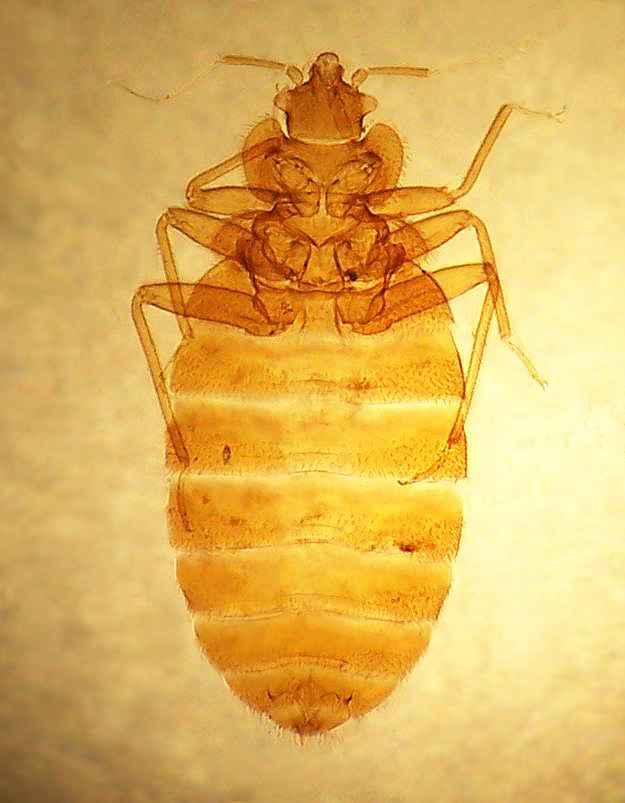
These insects are flat, oval shaped insects whose colors range from straw-colored to a mahogany brown. For this reason, some call the adults Mahogany Flats. The nymphs are almost translucent.
Upper Body
The upper body is crinkly resembling paper and covered by short, golden hairs. They are essentially wingless; the fore wings are symbolized by tiny vestigial scales. Their hind wings are absent. Their antennae can easily be seen.
Their first couple of segments looks angled. The microscopic hairs on their abdomens make them look banded or striped. They have compound eyes. These eyes are easily visible. Their eyes consist of 30 facets and look like cones.
Males are easily distinguished from the females because the end of their abdomen terminates into a sharp flap like segment. The end of the females’ abdomen is rounded.
Additional Characteristics
Their legs are very well developed. This allows them to crawl easily on vertical surfaces of plaster, wood and paper. They can climb up dirty glass, but with difficulty.
They are sometimes mistaken for other insects including carpet beetles and booklice, or vice-versa. Unfortunately, the current registered pesticide poisons do not affect this species.
How Many Species Are There?
There are 92 recognized species and the relatives in the world.
These bugs belong to the hemiptera order that includes a variety of different forms including scorpions and aphids.
The majority of the hemiptera order actually feed on the sap of plants. Actually, many of these species are carriers of very important plant diseases.
There are a few species in the family known as Cimicidae and families that are related that feed on the blood of mammalian and birds.
Various Species
Cimex lectularius is the common type. This species has adapted very well to human environments and lives in various climates around the world.
Cimex hemipterus is another species and is found in tropical regions of the world. In the United States, it is primarily found in Florida. This bug infests and feeds on poultry, bats and people.
The Leptocimex boueti is found in tropical regions of South America and West Africa. This species infests and feed on humans and bats.
The Cimex pipistrella, Cimex adjunctas and Cimex pilosellus are known as the bat bugs. These bugs for the most part infest and feed on bats.
The Haematosiphon inodora bug is found in North America. It chiefly infests poultry.
Oeciaus vicaruis is the swallow bug and Cimexopsis nycatalis, the swift bug
Clinical Information
These bugs are bloodsucking (hematophagous) insects. Most of the species only feed on humans when there is no other prey is available.
Cimicidae are tiny parasitic insects. Cimex lectularius is the most common kind and generally refers to the species whose preferred food is human blood. All the insects within this family survive by feeding entirely on the blood of mammals and birds.
Carbon dioxide, warmth and certain chemicals attract them to their hosts.
Their name is derived from its preferred habitat. They prefer to reside in houses, especially in beds or any other area where a person sleeps. Despite the fact that they are usually more active during the night, they are not considered to be strictly nocturnal.
Where They Live
Often they live in bedding or bird nests. This is to allow for easy access to the host they will feed upon. It generally feeds on the sleeping host approximately an hour before dawn.
There are various other names that they have been given including bed louse, mahogany flat, wall louse, wallpaper flounder, crimson rambler, redcoat, nightriders, heavy dragoon and chinche.
Survival Characteristics
Their life span will fluctuate and depends on the species of bug and the bug’s ability to feed.
They communicate using pheromones and chemicals. They communicate regarding reproduction, nesting locations and feeding.
They have the ability to survive a broad range of atmospheric compositions and temperatures. At temperatures below 61.0°F (16.1°C), the adult enter into a semi-hibernation state that helps them to survive longer in the colder temperature.
They are able to survive for five days in the least at a temperature as low as 14°F (-10°C). However, they will die after just fifteen minutes of exposure to -26°F (-32°C).
They demonstrate a high tolerance to desiccation by surviving in low humidity and a range of 95°F to 104°F (35°C to 40°C) even with the loss of 1/3rd of their body weight. The earlier life stages are much more likely to dry out than the latter ones.
Where They Struggle
C. lectularius has a high thermal death point of 113°F (45°C). All life stages are killed by seven minutes after being subjected to a temperature of 115°F (46°C).
These bugs are not able to survive in areas with a high concentration of carbon dioxide for any length of time. However, exposure to an atmosphere that consists of nearly pure nitrogen has shown very little effect even after 3 days in this environment.
Even though it can survive for an entire year without a blood meal, they will usually feed every 5 to 10 days. During cold weather, they can survive a year without feeding. At the temperatures that are more favorable to feeding and activity, they will live about five months.
In 2009, at the 57th Annual Meeting of the Entomological Society of America it was noted that the newer, pesticide-resistant generations of these bugs in Virginia survived only 2 months without being able to feed.
What Affects Them
We know that these bugs can be infected by no less than 28 human pathogens; no study has found that the bug has the ability to transmit any of these pathogens to a human being.
Interestingly, human blood meals recovered from bugs within 90 days still contain human DNA. This allows the DNA to be forensically tested. This assists in identifying the hosts the bugs had been feeding on.
These bugs discard their outer shells after molting. These discarded shells are clear and empty exoskeletons that resemble the bugs themselves. A bug has to molt six times before it becomes a fertile adult.
Several companies have begun to experiment with high-speed gas chromatography for the use of detecting these bugs and other insect pests.
How They Take Your Blood
This bug uses a stylet fascicle to pierce the host’s skin. This is a unit that is composed of the mandibles and maxillae, which have modified themselves into elongated shapes from a more basic, ancestral style. The left and right maxillary stylets are connected at the midline.
There is a section at the center that forms a small salivary canal and a large food canal. The whole mandibular; maxillary bundle penetrates the host’s skin. The tips of the left and right maxillary stylets are not identical. The left is straight while the right one is curved and looks like a hook.
The left and right mandibular stylets run along the outer sides of the maxillary stylets and do not reach the tip of the maxillary stylets, which are fused.
The stylets are kept in a groove within the labium. During the feeding process, the stylets are freed from this groove, which is jointed and then folds or bends out to release the stylets.
Teeth
There are small teeth in the mandibular stylet. These teeth move back and forth alternately affording the insect the ability to cut the tissue and make a path allowing the maxillary bundle to reach the appropriate sized vessel to obtain blood.
It will return to the same capillary repeatedly, which is why there will be multiple bites close to one another.
Once the insect has completed feeding, it will withdraw the stylet bundle and retract it back into the groove in the labium. It will then fold the whole unit under the head again and then returns to its dark and safe hiding place. It takes 5-10 minutes for the bug to completely engorge itself with blood.
Negative Health Effects
Several negative health effects can occur after a bite. These health conditions include psychological issues, skin rashes and allergy symptoms.
Cimicosis or bites sometimes lead to a variety of skin manifestations. Some forms have prominent blisters while others have no visible effects.
Positively diagnosing the patient with this specific bug bite rash requires locating the bugs and evidence of symptoms compatible with this rash.
Physical and Psychological Issues
Psychological issues are caused by these bloodsucking bugs because the patient may be hesitant to sleep. The patient may also have the sensation of bugs crawling on him when he is trying to sleep.
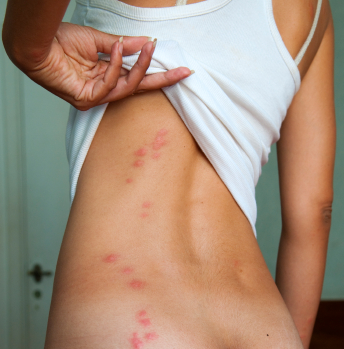
Bites will usually produce swelling around the bite similar to a mosquito bite. These bites can be distinguished from the mosquitoes bite because a these bites will have a red dot in the center that is similar to a fleabite.
The bites can take more than a week to appear and will generally be in groups of three. These bites will be about 6 mm or ¼” apart. Amazingly, approximately half of the people that are bitten will not show any signs of a bite whatsoever, they may experience nausea, anxiety or insomnia instead.
Indications of Infestation
These bugs do not indicate an untidy or unclean residence or establishment. They are found in some of the cleanest environments. They are often found in bedding, sheets, in wall cracks, in wood furniture and behind loosened wallpaper.
Because these bugs are usually somewhat nocturnal and elusive, they are difficult to find. They can usually be found in inconspicuous dark crevices. Eggs may be nicely nestled and attached with a sticky substance in the seams of fabric.
While they can be found by themselves on occasion, but generally congregate once they have become established.
If the insect itself has not been seen, there are a few telltale signs that indicate an infestation. These signs include molted skins, blood spots and tiny spots of excrement.
Bite Signs
The most noticeable sign is the bites an individual receives at night while sleeping. These bites can be anywhere on the body, however, they tend to feed on exposed areas of the host.
Therefore, these bites will generally be found on the face, neck, arms and legs. These bites will be in a row.
A Rather Unique Detector
They also can be detected by smell. They secrete odors with the smell characteristics of over-ripe raspberries, almonds or the herbs coriander and cilantro.
Just as dogs are trained to detect illegal substances by smell, New York has trained dogs for the detection of pinpointing infestations! According to tests conducted by researchers under controlled conditions, the accuracy rate of the pest companies’ dogs is possibly 97.5%.
Because this was a test conducted in a controlled setting, these tests do not necessarily reflect the success rates in the real world. This is due to the many other possible variables out in the field.
Whereas a practitioner of pest control may need an hour to pinpoint infestation areas, the dogs can usually detect the areas in mere minutes.
As of 2009, the United States has used approximately 100 dogs to locate these sneaky bugs.
Natural Predators
Cockroaches, spiders-in particular the Thanatus flavidus, centipedes, ants, mites and ‘the masked’ hunter.
The venom of the Pharaoh ant-Monomorium pharaonis is fatal. It is thought that biological pest control to eliminate them from dwellings is not incredibly practical.
How Infestations are Treated
One of the main reasons these bugs had nearly become extinct was because of harsh pesticides. These pesticides, including DDT, were used in the ‘60s and early ‘70s throughout much of the world as a way to treat insect infestations.
As countries began realizing the hazards associated with these harsh pesticides, they began banning them. At that time, it was unclear that the use of these pesticides was reducing infestations of these parasites.
To eradicate these bugs, many times it is necessary to use a combination of non-pesticide and pesticide approaches. Pesticides found to be effective in their eradication include dichlorvos, pyrethroids and malathion.
Pesticide Resistance
Pesticide resistance has increased quite a bit over time. There are many concerns of the possible negative health effects from using them. Instead of using pesticides, mechanical approaches are recommended such as heat treating or vacuuming the insects up. Many people have chosen to wrap their mattress and bedsprings to protect them.
Propoxur is a carbamate insecticide that is extremely toxic to these bugs. The Environmental Protection Agency in the United States is reluctant to approve this insecticide for use indoors. If children have chronic exposure to the chemical, it could be toxic to them.
However, this does not mean that a harsh pesticide is necessary for eradication. Today, there a several pesticides that is friendlier to the environment and safer to use.
These pesticides can also kill them easily. They can usually be eliminated with diligent vacuuming of carpet, steam cleaning of furniture and mattresses as well as frequent washing of bed linens in hot water and Borax.
Traditional Methods That Were Used to Repel and/or Kill
Some of the traditional methods for repelling and/or killing these bugs include using fungi, insects, plants, or their extracts such as, black cohosh, black pepper, Eucalyptus saligna oil, infused oil of Melolontha vulgaris, henna, Actaea, fly agaric, true turpentine, tobacco, Robert geranium, wild mint, bayberry, narrow-leaved pepperwort, bugbane, European cranberry bush, seeds and herb of Cannabis, masked hunter bugs and these are just a few.
The smoke from a peat fire was recommended in the 19th century.
For centuries, dusts have been utilized to ward off various insects from grain storage areas. These dusts include lime, plant ash, and dolomite, certain kinds of soil as well as diatomaceous earth or Kieselguhr.
Of these dusts, diatomaceous earth (in particular) has been revived as a nontoxic residual pesticide. When in amorphous form, this dust is nontoxic and is used for abatement. Insects that are exposed to this dust may take a few days to die.
19th Century European Techniques
In the 19th century, another way of protecting themselves from these bugs in France and the UK was used. The individual would place basketwork panels around his bed and then shake them out the following morning.
In the Balkans and southern Rhodesia, leaves of plants that had microscopic hooked hairs were scattered around the bed prior to retiring. These leaves would be swept up in the morning and then they would be burned.
Before the mid-20th century, these bugs were extremely common. In a report by the UK Ministry of Health, it was stated that in 1933, there were numerous areas throughout the UK where ALL the homes had some kind of infestation.
They were a very serious issue during World War II. A comment from General MacArthur stated that the bugs were “the greatest nuisance insect problem…at bases in the United States.”
Habit Change
Possibly, because of some of the insecticides we use today, they seem to be on the move. They tend to go from one room to another and are even becoming more active during the daytime.
People generally do not recognize them or the initial signs of an infestation. Until just recently, the majority of those under the age of 50 had never even seen one.
There Aren’t Any More Magic Bullet Insecticides like DDT
DDT has been gone for some time and so are all the other insecticides that were chlorinated hydrocarbon. Our modern insecticides seem to be ineffective. We are now facing bugs that have some level of resistance to insecticides.
Resistance to Pesticides
They have been developing pesticide resistance to numerous pesticides including organophosphates and DDT.
Some of the populations have become resistant to pyethroid insecticides. Although pyethroid is often ineffective, their resistance to this insecticide affords for investigation into other chemicals that work in different ways.
Because of continued exploration, chemical management can possibly continue to be involved with resolving infestations. There has been a growing interest in the use of synthetic pyrrole and pyrethroid insecticide, chlorfenapyr. Sometimes, insect growth regulators like hydroprene (Gentrol) are used.
Populations in Arkansas have become very resistant to DDT. In fact, studies that were conducted in Africa showed they became more active.
Escalation of Pesticide Resistance
Pesticide resistant bugs seem to be escalating dramatically. Populations that were sampled from across the United States displayed tolerance for pyrethroids greater than the laboratory bugs.
The bugs in New York City show a resistance to deltamethrin of 264 times more than the bugs in Florida due to their mutations and evolution.
A mitochondrial DNA marker was used in a study for population genetics of bugs in the U.S., Australia and Canada. This study found elevated levels of genetic variation of these bugs.
This would suggest that their populations did not go through a genetic bottleneck as would be expected from the insecticide control in the ‘40s and ‘50s. Instead, it suggests that the populations may have maintained by feeding on other hosts like bats and birds.
This is in contrast to the variations in genetics that was observed with the Mitochondrial DNA marker, there was no variation in the nuclear RNA marker. This would suggest they have increased gene flow of the previously isolated populations.
The absence of the barriers concerning the gene flow indicates that the spread of resistance to insecticide could be rapid.
Bed Bugs and the UK
Infestations of these bugs have been a problem in the UK for centuries, but the problem has definitely worsened in the last few years. Their problem seems to occur in cycles. In the early part of the 20th century, estimations suggest that approximately four million people located in London were being bitten regularly.
Some of the countries had even worse problems with approximately 33% of the homes located in Stockholm being infested during that time.
Returning with a Vengeance
Just like in North America, during the ‘50s and ‘60s the UK’s infestation problem began diminishing considerably. This decrease in the infestation is believed to be partly because of the newly developed insecticides becoming more available.
The problem has returned, according to some of the UK based companies for pest control. One company estimates that the amount of these bugs has risen by as much as 40%.
However, this percentage may not be very accurate because experts believe that many of the UK infestations are not reported. Understandably, there are a multitude of people who are ashamed when they find their home is infested. These people decide to try to eradicate the problem on their own, as opposed to reporting it.
What Has Caused the Increase in Infestation in the UK?
Again, increased travel overseas and people bringing the bugs back unknowingly is thought to be one of the main reasons for the increase in infestations. After hosting the 2000 Olympic Games in Sydney, the infestation in the country was enormous, with estimations that approximately 95% of the hotels located in Sydney were affected.
Some of the experts think that the weakened UK economy is also one of the reasons for the rise in their population. This is because more people are traveling between the cities looking for work and many times staying in hotels.
It is thought that these individuals may be inadvertently carrying the bugs to the various locations in their luggage and on their clothing.
They are not only found in the hotels, motels and Inns of the UK, they can usually be found in the airports, other transportation vehicles and railway stations too. The larger cities that have a more transitory population tend to have greater infestations.
Second Hand Clothes & Other Items
Another issue is the increased number of individuals purchasing second hand clothes, furniture and bedding. They are often found in older bedding, sheets, mattresses and clothes.
Pest control companies do not always identify the cities or towns that are infested. This is because the local councils do not want the public to know that there could be a problem in their area.
How is the UK Dealing with the Resurgence?
Pest control companies within the UK have been attempting to alleviate their problem with bugs by trying to destroy them with a new chemical. Their strategy is somewhat effective; however, eventually the bugs will once again develop immunity to the chemical.
The reality is that any of the experimental or new chemicals that are being used today will eventually be useless in the battle. Once this happens, the search will begin for another new chemical to assist in eradicating these bugs.
Lawsuit against a Top London Hotel
Despite efforts to get rid of them, many of the top hotels are still plagued with these little pests. In fact, in 2007 there was an incident concerning an infestation at one of the top hotels in the UK.
This luxurious, top of the line hotel was the Mandarin Oriental located in London. A very prominent attorney along with his wife sued the Mandarin Oriental for several MILLION dollars.
While staying at the hotel for a total of five days in 2006, they suffered hundreds of bites. The couple also stated that the bugs had crawled into their clothing and luggage, returned to the United States with them and then proceeded to infest their New York apartment.
Case Outcome
This court case has paved the way for several other lawsuits. These cases have occurred overseas as well as in the UK. It is difficult to determine how many cases there have been since hotels do not welcome the negative publicity that is associated with an infestation.
If these bugs are encountered in a hotel or accommodation that has been rented, it is important to notify someone immediately so they can be exterminated.
Bed Bugs and the Economy
Not only are their bites uncomfortable and sometimes expensive to eliminate if a secondary skin infection occurs, but there are other consequences of an infestation.
Hostels and hotels have been sued by guests that suffered bites and/or rashes while staying at the establishment. However, usually the establishments will settle with the previous guests out of court attempting to avoid the negative publicity.
Hotel Rate Increases
The threat of possible lawsuits has led to rate increases at some hotels. The extra revenue is used to enact a very thorough extermination plan. Some hostels have resorted to measures that are more drastic. They are making it a policy that all guests MUST shower prior to entering their room.
First, we have to contend with the high fuel costs and now some of the smaller airlines have been forced to raise their rates to hire a more thorough cleaning service. This cleaning service is necessary to eliminate any bugs that are attempting to ‘stow away’ in the luggage holds and seating areas of the plane.
The European Union
Most of us grew up with our parents putting us to bed with the familiar phrase ‘Night, night, sleep tight and don’t let the bed bugs bite,’ then they would run their hand up our leg and stomach mimicking a bug. However, many parents are not aware that this bug is a real insect that packs a nasty bite.
Another one of the areas that has started to see a notable increase in infestations is Europe, despite their efforts to reduce or control them. In some parts of Europe, the infestations have nearly DOUBLED with each year that passes.
I hope that we will have the ability to rid ourselves of these irritating insects in the near future.





38 Comments
use 50ml of malathion and 25ml actellic and 25ml of permethrin and 25ml of pbo 8 per gallon spray that a bulls eye against bed bugs? or not?
Also in the late 40’s and 50’s many people started covering their furniture in plastic covers, which makes it hard for the bugs to hide in and too slippery for them to climb. Those easy to clean covers were keeping bugs out of the sofas and chairs.
yea… theyre on the move… they went from my bedroom during intial infestation, then relocated to the middle of my apartment, by the kitchen, between the bedroom, and the lounge chair in the living room I now have to sleep in sometimeszx after the first pesticide application… so yea theyre right in between the two sleeping spotszx now
They are extremely sensitive to scents and move extremely fast. You essentially have to use yourself as bait to get them stay in one room which is the food source and then continously steam the corners and crevasses to kill. For a bad infestation we are using heat in Canada. A professional service comes in a basically cooks your house killing adults, nymphs and eggs.
As an exterminator these are the toughest pest we battle. There is no silver bullet. Elimination of an infestation can be accomplished if the tenants and the pest operator work together. Do not waste your money on snake oil treatments on the internet. Very few people get lucky and eliminate their problem with those cures. Of course very few people hit the lottery so although it happens its not a good retirement program. Education of everyone that has blood (food source) is the only way mankind will get ahead of this scourge. Sorry to say it is not cheap.
Do not use any form of pesticides. The nly way to truly kill every cycle is with a heat treatment which can take 4 to 8 hours pending the size of your home.
I discovered I had a beginning infestation. I bought these basic products: I chose to go to Amazon. I bought four one-quart spray bottles. One gallon high grade rubbing alcohol, one-gallon high-grade white vinegar. Tea tree oil (and other recommended oils). Dilute as recommended. These were used as the “immediate kill sprays.” Mix with water as directed on the internet. Second, (to begin) buy two bottles of highly recommended residual spray (it sticks for a couple of weeks). Buy a bag of DE specifically noted for bed bugs (this scratches them to death). Buy a drying powder (this dries out them out). Buy Cinimex (I don’t know what this is but this is terrific!). Move your bed away from the wall and move anything close to your bed away from it. Next, bag all your sheets, blankets, bed things and seal the bag. Wash them in hot water and dry for no less than 45 minutes in a hot dryer. Get a flashlight and look everywhere suggested on the internet for bed bug “nests.” Get out that high-powered vacuum cleaner. Get out your steamer. Go at it as directed on the internet. Kill and destroy. Vacuum, steam, use immediate spray, then use residual spray. After THAT dries, use the DE together with the powder drying agent and together with Cinemax. I used a make-up type brush to spread the DE and other powders on everything — the bed and everything surrounding the bed. I also washed everything, like clothing that may have come in contact with the bed. Wait three days and repeat the whole procedure AGAIN. Do AGAIN in another three days. Then every four days. Keep doing this every 5 days for three weeks. Then every once per week for three months minimum. I saw less and fewer bugs, then dying ones, then dead ones, then none — but don’t let up! Don’t stop! Three months keep at it. I think I got ’em. But I had only a minor infestation limited to one bedroom. If you have more, this may not work. Don’t forget to keep up the vacuuming and bed changing. You cannot get lazy and let up the fight. That is key. Even after you think you’ve got ’em, be preventative and keep these procedures going at least every 10 days. Remember, they can return at any time because those beasts live all over this planet. Keep reading everything you can get your hands on. The internet is a godsend. Don’t stop educating yourself. Just when you think you know everything. You don’t.
I love bed bugs. They don’t carry diseases, and they don’t smell bad. They are a naturally occuring animal and deserve to live, too.
Obviously you have never had to deal with these bugs in your home. I must have thousands of bites all over my body. I get woken up at night because I itch. I see them crawling on my bed, my clothing and me. It costs somewhere in the neighborhood of $3,000 to have an exterminator come in to get rid of them. So, needless to say, we have to live with it because we don’t have that kind of money. Personally, I hate these things and I wish they would go away forever.
Listen…a week ago..I seen what looked to be a tick on my dog..so I plucked it off…then I noticed another one a few days later..but noticed it looked different…I looked it up…sure enough..I fuckin panicked..I flipped my couch over and ripped the bottom off of it..I made my hand red…pushing hard through every crack in the couch..vacuumed every day..still am……its been 3 days..and I must say…I think I have gotten almost all of them….u can do it!!!..just start cleaning..scrubbing everything..vacuuming everything..
Nope. They go through AC vents . Under shoe moulding. I’ve tried
On youtube I saw videos of propane heaters used to kill bed bugs and care to ventilate the deadly carbon monoxide fumes. I saw used ones on craigslist for 130 dollars.
I hav started using essential oils 2 get rid of mine, seems 2 b wrkng. Good luck
Spray them with alcohol that works that’s what I’ve been doing and sprinkling that white power down under the bed
Apparently, your ability to recognize sarcasm is quite diminished.
You’re an idiot.
You are crazy, animals? I take your vegetarian or do you eat a bowl of bed bugs, nasty!
I’m vegan I hate them. Kill them with fire. I have no problem with killing pests. They are a nightmare to live with and they are not emotionally intelligent like animals other animals are.
Wtf like seriously they need to be extinct and if I had a chance to make them extinct I would
Are you an undercover bed bug? Tell the truth.
When you realize that there are people that are allegic to them and even when they crawl on them it can cause horrible itching and irritation then talk about how wonderful they are
These bugs are a blight on society. I don’t think that they were even missed from the food chain when we had them beat before. They are useless. You obviously haven’t ever had the pleasure of dealing with them before. I’d love to see what you have to say after you do, if you do, God forbid.
I hope your house gets infested and you have to throw everything you own out. They disgusting creatures that only deserve to survive in the caves they originate from. That’s the only use i have for them.
you are crazy!!!
The biggest problem is people are only paying attention to adult bugs, as Mr Louis says. I’ve been bitten all over SE Asia in spite of checking mattresses and often finding no signs. Most people would call me delusional, because they don’t realise the effects of nymph bugs, and they don’t feel the bites. The fact is, the new born bugs are very hard to see.
I see them often. They are so tiny and lightly colored that they are hard to spot. These pests are a nightmare.
The smallest ones, the babies, are felt the most. Their bite doesnt have the numbing sensation that the adults do.
Scientists need to introduce cancer to their kind, or at least a disease that acts like it really fast, and only affects those pests! We have to hit them with biological methods that kill their white blood cell count.
Use DE … Diatomaceous Earth. It is cheap and works. My daughter was waking up at night bc of bites all over her body. Broke my heart when I caught her sleeping on the couch bc something was biting her. Checked and we found hose horrible bugs! U have to sprinkle it everywhere I mean everywhere leave it there for like two weeks. Vacuume regularly. Cover he mattress with a zip cover. At night put double sided tape around the edges so when they come where u havnt seen them they get stuck. It worked for us! After a month they were gone. Thank God. Anything that comes in our hs get the dryer now!!
I concur with the usage of diatomaceous earth. We’ve been using it for a little over a week and we haven’t seen any in our bed! Like someone else mentioned here, you really have to look out for the baby bed bugs because they’re almost transparent! Anyway, so far so good. For those of you that believe in prayer, please pray for us, as these pests have really turned our lives inside out!
Shawn Jones
I can’t get rid of these nasty bed bugs one year ago I got them from a motel a year later I’m still getting occasional bites. Now a year later I stayed at another motel and got bitten so bad on my wrists and arms and legs. I have been using raid spray. Now I am going to bomb the basement where they mostly r. I’ve only seen one. But they r there. Question? Can they come from a closet w a sump pump the closet and mold??????? Help.
I had them in my apartment a few years ago and got rid of them myself without exterminators, expensive or worthless treatments. I had been living there almost a year when I got them. It started off with a few bites between me and my boyfriend. At first we thought it may have been mosquitos getting in because our bedroom windows had no screens or we may have had fleas from dog sitting for a friend but it just wasn’t that bad at first. All our furniture was brand new when we moved in and we are very cleanly people so we never thought bed bugs. Then he went away for work and they only had me to feed on and boy did they! I called my apartment and they said how did I know that’s what it was. Lol, because I caught one in the wee hours of the am and I have him in a jar on my counter if you want to get technical I can call the health board. They sent maintenance with some ridiculous looking foggers for roaches I’m pretty sure and said I would have 2 throw my brand new bed and couch away. I told them not unless they were replacing them because I did not have bed bugs before I moved there and everything was new out the plastic. So I started researching but was getting nowhere special it seemed and was exhausted because I couldn’t sleep anymore and wouldn’t have company in fear of spreading them to another house. I felt like I had the plague in my home and I was on my own when I found them I finally broke down and told my mother even though I was embarrased to even tell her. She then called my aunt who had worked in New York City hospitals and homes as a nurse and caretaker. These were here exact directions I used and they were gone after one round. Remove all bed linens including pillow cases and dust ruffles, take all clothing table clothes especially anything in a drawer or near the floor, table cloths, curtains, rugs… yea I know it sucks etc. Wash them in the hot or warm water depending on color and dry them on the highest heat setting. Remove mattresses and box spring from frame. And this is where I found mines sleeping spot. Then go to any drugstore and get a couple or more bottles depending on size of home of 91% isopropyl alcohol and a big spray bottle. This stuff is strong so you only need maybe half a cup and the rest water. Then open your windows first and spray mattresses( I also bought bed bug covers with zippers that would not let anything escape or get in and new pillows), rails frames, inside drawers and bins, closets, base boards, cracks, crevices, corners, take out or spray in between couch cushions and spray any part fabric (luckily I had leather). Lord, I even sprayed my bathrooms, kitchen , cabinets, and laundry room and over my carpet. Then leave your windows open and leave for about 2 or more hours. You may want to invest in a mask for your nose mouth and or eyes as well because this solution is strong enough to make you pass out when sprayed. Needless to say when I returned I couldn’t find one live one. You may also find any other hiding critters dead as well(a plus). I vacuumed and wiped down counters and such and waited a few days before I put everything back. It wasnt even $300 for this remedy verses the $500 or usually alot more most exterminators charge. Now if you stay in a huge home or your problem is beyond a certain point or is in multiple spaces you may have to get a professional service in but I never heard from or woke up to them again. And got my life back! I believe they may have came from my neighbors apartment who moved out suddenly because I did find in my research that they will travel so many feet when their food supply is gone or worst case scenario one of our trips where we stayed in a hotel. And not even a sketchy one. Not sure, but I am now extra careful when I leave home even at peoples houses. Bags stay on tables and counters not beds, floors or couches and I empty them outside before coming in. Yes,my neighbors look puzzled sometimes but I know it’s better than the alternative. Hope this may help someone else in the future.✌
One of the most frustrating things about bedbugs is that they are so easy to kill when they get on you! Get one between your thumb and index finger, squeeze, and send it to bug heaven! Unfortunately, since they are prolific breeders, there are way too many to exterminate that way. It takes extreme diligence to get rid of them.
Don’t sleep or lounge around anywhere in your house except for your bed. Put bed bug discs on the foot of each corner of your bed and don’t let any blankets touch the floor. Then go from there you are the bait set your alarm clock for 3 a.m. and kill everything you see keep a large Flashlight by your bed. Change the bedding constantly and spray bleach along all its bottom edges or anywhere they’ve been hanging out on your bed and leave the room do this every single day you’ll be rid of them in a week.
Cimexa, cimexa, cimexa. Use cimexa. It is a mechanical killer meaning they can’t develop resistance to it since it permeates the exoskeleton of the insect. It’s the same ingredients found in those little food packets that say “do not eat” to keep the food dry. It dries them out. A lot of people tote diatomaceous earth but it’s extremely messy and hard to clean up, plus it takes days if not weeks to be truly effective. DE made me have some breathing issues, headaches, and nausea (no it wasn’t the toxic stuff, just similar side effects others have had too). Cimexa has been proven to be 95%+ effective in as much as 3 days. All you need is a thin layer and it’s much easier to spread than DE. It also has the perk of lasting up to 10 years. I had tons of dead nymphs days later after using it, and the bigger bed bugs started coming out more (which is good in the short term, meaning they’re dying and going crazy to survive) so I got to kill a few in the process as well. Sprinkle it everywhere, on everything. Use a brush and a puffer bottle. Around the edges of your beds and walls, underneath the bed frame (literally found a couple of small egg harborages on the underside of my bed frame). Educate yourself on what’s out there. Cimexa *combined* with a reputable exterminator with good residual spray has brought my infestation to a halt, and in another week hopefully I won’t see signs of anymore.
i tell you what if you turn on a fan and you see these white little things that look like lint flying around you are infested about as bad as it gets. I knew i had them but when i turned on my sealing fan all these little white thing where flying all over they were glistining in the light coming threw the window and was landing on me i got one of those peace’s of lint on my finger and i could feel it sucking my blood and watched it turn darker.After that i vacumed the house real good and that helped a hole lot thats prob. the best thing you can do and then spray all the furniture. Good Luck
Vacuum vacuum vacuum everything you can not put in the washer and or dryer. Spray pesticides in the worst places and diatomaceous earth cracks, cervices, baseboards and any of the tiniest places you can find. They can slide into a space small enough for a piece of paper so vac and treat everything. You will not get them all right away, they just hide too well but keep going. They will have to come out to feed eventually and then kill them if you see them. My dad used to give me Vitamin B1 when I was little when I was going to be out where mosquitos were. They love me. This did help with the bites of bed bugs too to a degree. It makes you undesirable. My bites have been fewer and smaller. That may be due to the vitamin or maybe me just being diligent about the tasks of what has become my everyday. I have learned that Vitamin B1 is very necessary for all of us esp as we age to increase it. So this is a good thing to find out. I have also been cleaning a whole lot more which is a wonderful thing too. So to say they have absolutely no purpose is not quite the truth at least indirectly. They are a nuisance to be sure and if they were eradicated that would be just fine with me. As far as I am concerned the ones I have are done here and will not be transferred to anyone else. That is what keeps me going. I won’t stop until they are gone and even then…..
I am both cursed and lucky at the same time, when it comes to bed bugs. I have an allergy to bed bug bites. My allergy is severe enough that it can be FATAL. Just one tiny bite by only one little baby bug will give me hives and rashes and pus and swelling and angiodema so severe, that within hours my face will turn into a rubber balloon. The fatal curse of it is if by mere accident the bite occurs on my neck instead of my face, the neck will swell within itself so that it will block the air passage. Once I stop breathing, I’ll choke to death within a couple of minutes. So, when I think of bed bugs, I think of death. They are literally fatal to allergic people. But on the other hand, my allergic reaction to them is a blessing. Once upon a time, when somebody in the house, where I lived, brought a bed bug in from the laundry, I woke up with a scary blownup face. So, as soon as I turned into a swollen-face monster upon waking up in the morning, I looked at the swelling and noticed the small red center point – the point of the bite itself. If I ever see an instant gigantic swelling and a bite point, I don’t even need to see an actual bed bug for confirmation. I KNOW there is one. But when there is just one or two bed bugs in your home – you can take measures to kill them before they reproduce further. And when I see other people, living with bed bugs – it usually takes them months to realize they even have any bugs. Since they don’t have an instant allergic reaction, they wake up without seeing anything but just having a little itch. They every time assume that it must have been a mosquito bite. By the time they realize they have bed bugs – it’s too late to exterminate them by their individual efforts. So, without the allergy, most people realize the bed bug presence when it’s not one bug but thousands of them. And when people start itching all over their body every single night and then and only then they decide to look inside their bed – that’s when they notice weird red spots all over and “strange” insects in their bed…too bad they are not blessed with allergy. But sady, then they agree and say: “oh yeah – I have some weird bug in my house. But I took my bed sheets with all the bugs to the laundry and washed them. So, I killed them.” If I say :” No, idiot – that’s not enough because you have to also treat the whole matress, bed frame, floors, furniture, curtains, wash all your clothes, dry them on high heat, and basically insulate and treat your whole fucking house!” , they’ll reply with: “You are just being paranoid. Don’t be so crazy.” But then, they start walking around with bed bugs crawling on them and nothing they do works to get rid of them. Some people are really that stupid! They will forever try to wash their sheets in a laundry, and when the problem keeps coming back – they will finally decide to relocate to another housing, spreading bed bugs more throughout the world. I know it becasuse I lived in a housing complex with multiple apartments/flats. And the entire building was infested, expect just my unit. Everyone thought I was crazy to seal the entrance doors and drop diatomaceous earth everywhere around entry door and inside my house. But they had no allergy and they never knew or did their research on bed bugs! The didn’t have to go to Emergecy Room due to severe allergic reasction. So, they didn’t bother even to think why they often itch here and there every time they sleep. So ignorant!
To conclude, my allergy turned my body into a living bed-bug-detector, which works so perfectly and instantly. It works better than any pest control company or glue traps. And that’s a true blessing. One thing I learnt due to my own lack of funds and I can advise it to those who have no money to move is the following. First of all, as harsh as it might be, the truth is, if you have an allergy to bed bugs and you moved to an infested house and cannot afford to move out- you’re better off going homeless or in a shelter (as long as the shelter isn’t infested either!). Even if you are homeless, you can still breathe and will not die within minutes from choking. But if you stay in the infested house – you MIGHT DIE without any protection!!!! Second, if you can’t leave and they are other people living with you, you can temporarily protect yourself from a possibility of choking to death by using two very repellant chemicals together: sunblock cream AND mosquito-repellent spray. Sunblock cream is very poisonous and sticky and super bitter. With heavy sunblock cream on your skin no insect will want to bite you. Anti-mosquito repellant is not as effective for hungry bugs, but it will add some nastiness to the surface of your skin on top of sunblock. If you want to save your life until you find a new place to live, put lots of sunblock cream at least on your neck. Let them bite your arms and legs, but NEVER YOUR NECK. You won’t choke from swollen legs or arms, not even face, but neck -YES! So, put that sunscreen all over the neck. Trust me – no mosquito and no bed bug will want to bite you through heavy layers of sunblock! I am the survivor. And I have an allergy to bed bug bites. I read somewhere that you might get an EPInephrine dose from a doctor, just in case of life-threatening emergecy as well. Epi-dose saves your life in case of angiodema.
Now I’ll rant a little bit about the uneducated masses. Only ignorant people would say bed bugs are just a nuisance. Bed bugs are a public health threat and they CAN BE FATAL to most vulnerable people: THE BLIND, PARALISED OR DISABLED people, THE ELDERLY with poor vision and other impaired senses, THE ALLERGIC ONES and INFANTS/YOUNG CHILDREN. Don’t be ignorant. Be vigilant and take care of yourself.